
Blog
We’re here to connect, collaborate, and support your packaging journey. Let’s talk and build smarter, sustainable solutions together.
How to Choose Foodservice Paper Packaging for Hot, Greasy, or Takeout Foods
How to Choose Foodservice Paper Packaging for Hot, Greasy, or Takeout Foods
Choosing the right foodservice paper packaging for hot, greasy, or takeout foods directly affects food quality, customer satisfaction, and daily operations.
A box that leaks, softens, or traps steam can damage both the meal and the customer experience.
That is why foodservice paper packaging should be selected by use case, not by appearance alone.
This guide covers how to compare materials, structure, grease resistance, heat performance, and supply considerations.
The goal is simple: choose packaging that works reliably in real service conditions while still supporting cost control and brand presentation.
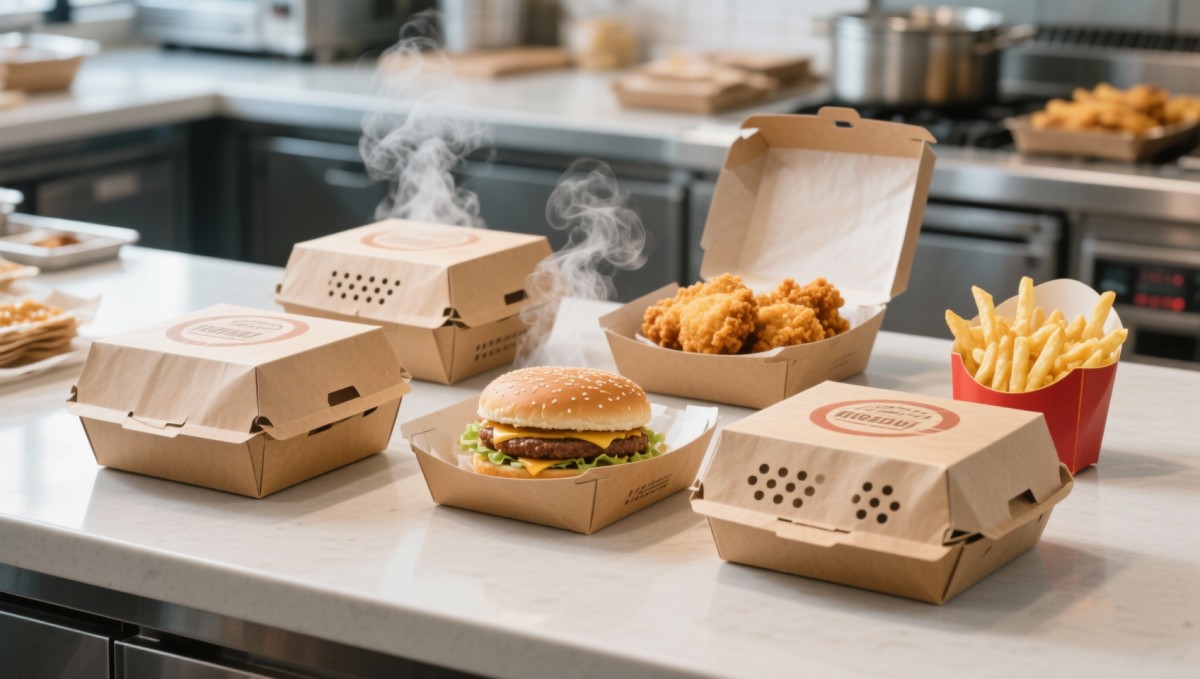
Start with the Food, Not the Package
The fastest way to make a poor packaging decision is to begin with a catalog instead of the food itself.
Different menu items create very different packaging demands.
Hot fried foods release oil and heat at the same time.
Roasted items may stay dry at first, then release moisture during holding or delivery.
Saucy takeout meals need containment, sealing strength, and a base that will not collapse.
Before comparing foodservice paper packaging options, define these points:
- Serving temperature at packing time
- Oil, sauce, or moisture level
- Expected hold time before eating
- Delivery distance or carryout duration
- Portion size and stacking needs
- Whether venting is required to protect texture
This step narrows the field quickly.
It also prevents overbuying features that do not matter for the actual menu.
Check Heat and Grease Performance First
For hot and greasy foods, performance starts with barrier protection.
If the paper absorbs oil too quickly, the pack weakens, stains, and becomes harder to handle.
Good foodservice paper packaging should resist grease long enough to match actual service time.
That sounds obvious, but many issues appear after just fifteen to twenty minutes.
When reviewing packaging, pay close attention to these factors:
- Grease resistance for fried chicken, pastries, burgers, and snacks
- Heat tolerance for freshly cooked foods
- Resistance to softening under steam
- Base strength when carrying heavier portions
- Seal integrity around folds, corners, and lids
From a practical standpoint, heat and grease should be tested together.
A pack may handle grease well on the shelf but fail once hot steam builds inside.
That is especially common with takeout foods packed immediately after cooking.
Match Structure to the Takeout Journey
The right paper grade alone is not enough.
Structure matters just as much in foodservice paper packaging.
A good design should survive filling, closing, stacking, transport, and handling by the end customer.
For short counter service, a lighter construction may be enough.
For delivery, structural demands increase quickly.
Ask these decision questions before final selection:
- Will the pack be stacked inside insulated delivery bags?
- Does the lid stay closed under pressure?
- Can staff fill it quickly during peak hours?
- Does the base hold shape after thirty to sixty minutes?
- Can customers carry and open it without spills?
This is where many buyers shift from unit price to total operating value.
A slightly stronger pack can reduce remakes, complaints, and handling issues during rush periods.
Do Not Ignore Ventilation and Texture Control
For many hot foods, sogginess is a bigger problem than leakage.
Steam trapped inside foodservice paper packaging can quickly ruin crisp coatings and baked surfaces.
That makes ventilation a key selection point.
Fried foods, grilled items, and warm pastries often benefit from controlled venting.
On the other hand, foods that dry out easily may need tighter closure.
In actual operations, the best result usually comes from balancing these two risks:
- Too little venting causes condensation and texture loss
- Too much venting reduces heat retention and product appeal
This is why real menu testing matters more than product descriptions.
Run the same food through the full takeout cycle and compare texture after arrival.
Evaluate Daily Usability for Staff and Service Speed
Packaging decisions are often made in meetings but succeed or fail at the packing station.
Foodservice paper packaging should support fast, repeatable work.
If a pack is awkward to open, unstable to fill, or hard to close, service speed drops.
That creates hidden cost even when the material price looks attractive.
Useful evaluation points include:
- Ease of storage in limited back-of-house space
- Simple one-step or two-step assembly
- Reliable closure during rush periods
- Clean appearance after filling
- Clear fit with bags, trays, and delivery systems
A useful packaging trial should involve both kitchen staff and delivery handling.
That usually reveals issues early, before they become expensive ordering mistakes.
Compare Cost Beyond the Unit Price
Price matters, but it should not be the only decision filter.
The lowest-cost foodservice paper packaging may create higher total cost in operations.
Leaks, product damage, customer complaints, and repacking all reduce the real value of a cheap option.
A better way to compare options is to review cost through business impact.
This comparison gives a more realistic basis for selecting foodservice paper packaging that performs under pressure.
Choose a Manufacturer That Can Support Consistency
Even a strong packaging specification can fail if supply quality changes from batch to batch.
That is why supplier evaluation matters as much as product evaluation.
For importers, distributors, wholesalers, retailers, and foodservice companies, consistency is the real long-term advantage.
Look for a manufacturer that can offer stable production, clear communication, and export experience.
XG Paper Manufacturing Sdn. Bhd., based in Malaysia, produces disposable paper packaging for global customers with a focus on dependable manufacturing and practical service support.
Key strengths include reliable manufacturing in Malaysia, consistent product quality, competitive pricing, OEM and private label support, and professional export handling.
For buyers sourcing foodservice paper packaging from Southeast Asia, that combination can reduce risk and simplify procurement.
A Practical Selection Checklist
Before placing an order, run through a short decision checklist.
- Match the package to food temperature, oil level, and moisture release
- Test foodservice paper packaging with real hold and delivery times
- Check for grease resistance, heat stability, and bottom strength
- Review venting based on texture goals
- Confirm fast packing and secure closure during peak service
- Compare total operating value, not only purchase price
- Choose a supplier with consistent manufacturing and export capability
The best foodservice paper packaging is the option that protects food quality, supports smooth operations, and stays reliable order after order.
If you are reviewing packaging for hot, greasy, or takeout foods, a structured trial with the right manufacturing partner is the clearest next step.
That is usually where better packaging decisions become easier, faster, and more commercially sound.